Conversational Data Exploration with Snowflake Intelligence
How AI-powered analytics in Snowsight complements modern BI tools like Qlik for deeper insights and faster decisions.
The Future of Data Interaction Is Here
For years, business intelligence has relied on dashboards, reports, and predefined queries. While powerful, these tools often require users to know what to look for before they begin.
Snowflake Intelligence is changing that paradigm.
By enabling natural language interaction directly within Snowflake, organizations can move from static dashboards to dynamic, AI-driven exploration, where users simply ask questions and receive meaningful, contextual answers instantly.
What Is Snowflake Intelligence?
Snowflake Intelligence is an AI-powered conversational analytics interface built into Snowsight. It allows users to:
- Ask questions in plain English
- Generate SQL automatically
- Retrieve both structured and unstructured insights
- Explore data without deep technical expertise
Behind the scenes, it leverages Snowflake Cortex AI services, including:
- Cortex Analyst for structured data (Natural Language -> SQL)
- Cortex Search for unstructured data retrieval
- LLM-powered reasoning to orchestrate responses
Why It Matters
1. Democratizing Data Access
Business users no longer need to rely on data teams for every question. Snowflake Intelligence enables true self-service analytics.
2. Faster Time to Insight
Instead of navigating dashboards or writing queries, users can ask:
“What product category has the highest margin this quarter?”
…and get immediate results.
3. Bridging Structured and Unstructured Data
Snowflake Intelligence can answer questions like:
“What documents discuss pricing strategy?”
This unlocks insights that traditional BI tools typically cannot access easily.
When to Use Snowflake Intelligence vs. BI Tools
Snowflake Intelligence does not replace tools like Qlik Sense or Tableau—it complements them.
.png)
The diagram below illustrates the key differences between Snowflake Intelligence and BI tools integrated with Snowflake AI.
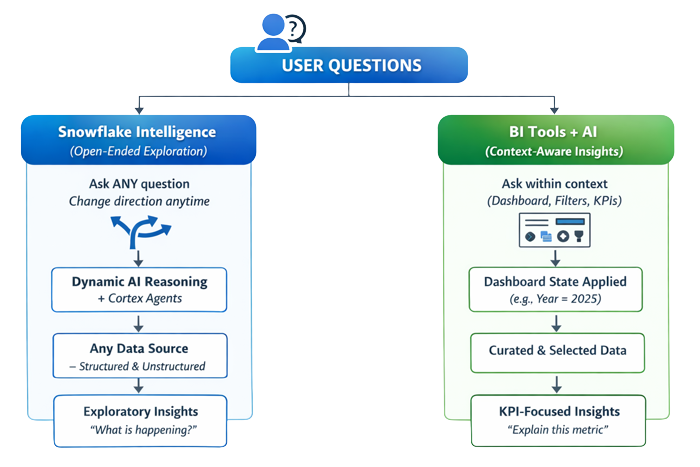
Key takeaway:
Use Snowflake Intelligence for exploration and discovery, and BI tools with Snowflake AI for dashboard-driven insights enhanced with conversational capabilities.
Real-World Use Case: Wholesale Business: From Exploration to Dashboard
Consider a wholesale distribution company managing thousands of products, suppliers, and regional customers.
Step 1: Exploration with Snowflake Intelligence
A business analyst begins with open-ended questions:
- "Which product categories are underperforming this quarter?"
- "Which suppliers have increased costs recently?"
- "Are there any issues mentioned in supplier communications or contracts?"
Using Snowflake Intelligence, the analyst quickly:
- Identifies declining margins in specific product categories
- Detects cost increases tied to certain suppliers
- Surfaces insights from unstructured data such as supplier emails or contract notes
👉This phase enables rapid discovery across both structured sales data and unstructured business documents—without requiring predefined dashboards.
Step 2: Operationalization with Qlik (or BI Tools)
Once insights are validated, the team builds dashboards in Qlik to:
- Track product margin and sales performance by category and region
- Monitor supplier cost trends and reliability KPIs
- Provide procurement and sales teams with consistent, real-time visibility
👉This phase focuses on standardized reporting, KPI tracking, and executive-ready visuals.
Outcome
- Snowflake intelligence accelerated data discovery and root cause analysis
- Qlik enables scalable, repeatable performance monitoring
Together, they empower wholesale businesses to move from reactive reporting to proactive, insight-driven decision-making.
Best Practices for Success
To maximize value while controlling cost and ensuring accuracy:
- Build Strong Semantic Models
- Clearly define relationships, metrics, and dimensions
- Reduce ambiguity for AI-generated SQL
- Encourage Efficient Queries
- Favor aggregated results over large datasets
- Limit result size to reduce token usage and compute cost
- Use Verified Queries
- Predefine common business questions
- Improve consistency and trust in responses
- Optimize Compute
- Use smaller warehouses (e.g., XS) for AI workloads
- Monitor Usage
- Track token consumption and query patterns
- Continuously refine for efficiency
Getting Started
A simple adoption path:
- Identify a pilot use case (e.g., inventory or pricing analysis)
- Validate business value with real users
- Scale successful outcomes across additional use cases and teams
Final Thoughts
Snowflake Intelligence represents a shift from dashboard-driven analytics to conversation-driven insights.
It empowers users to:
- Ask better questions
- Explore data freely
- Make faster, more informed decisions
When combined with modern BI platforms like Qlik, it creates a powerful ecosystem where exploration and visualization work hand in hand.
To get started contact us for expert support today.
.jpg)