
Pipelines, platforms, and plumbing your analytics can rely on
Analytics gets the credit. Engineering carries the weight. DI Squared has been building the pipelines, warehouses, lakehouses, and integration layers underneath enterprise analytics since 2008. Snowflake, Databricks, dbt, Fivetran, Azure, AWS, Google Cloud. Vendor-neutral, fluent in the platforms that matter, and built to merge thoughtful architecture with long-term strategy.
Snowflake, Databricks, dbt, Fivetran fluent
HQ Atlanta, serving US, Canada, Europe
- We design and build the data platform under your analytics
- Pipelines, warehouses, lakehouses, integration, governance scaffolding
- Platforms: Snowflake, Databricks, dbt, Fivetran, Azure, AWS, Google Cloud
- Method: Discover, Map, Navigate, Adjust
- First engagement is usually a current-state platform assessment
What do data engineering services include
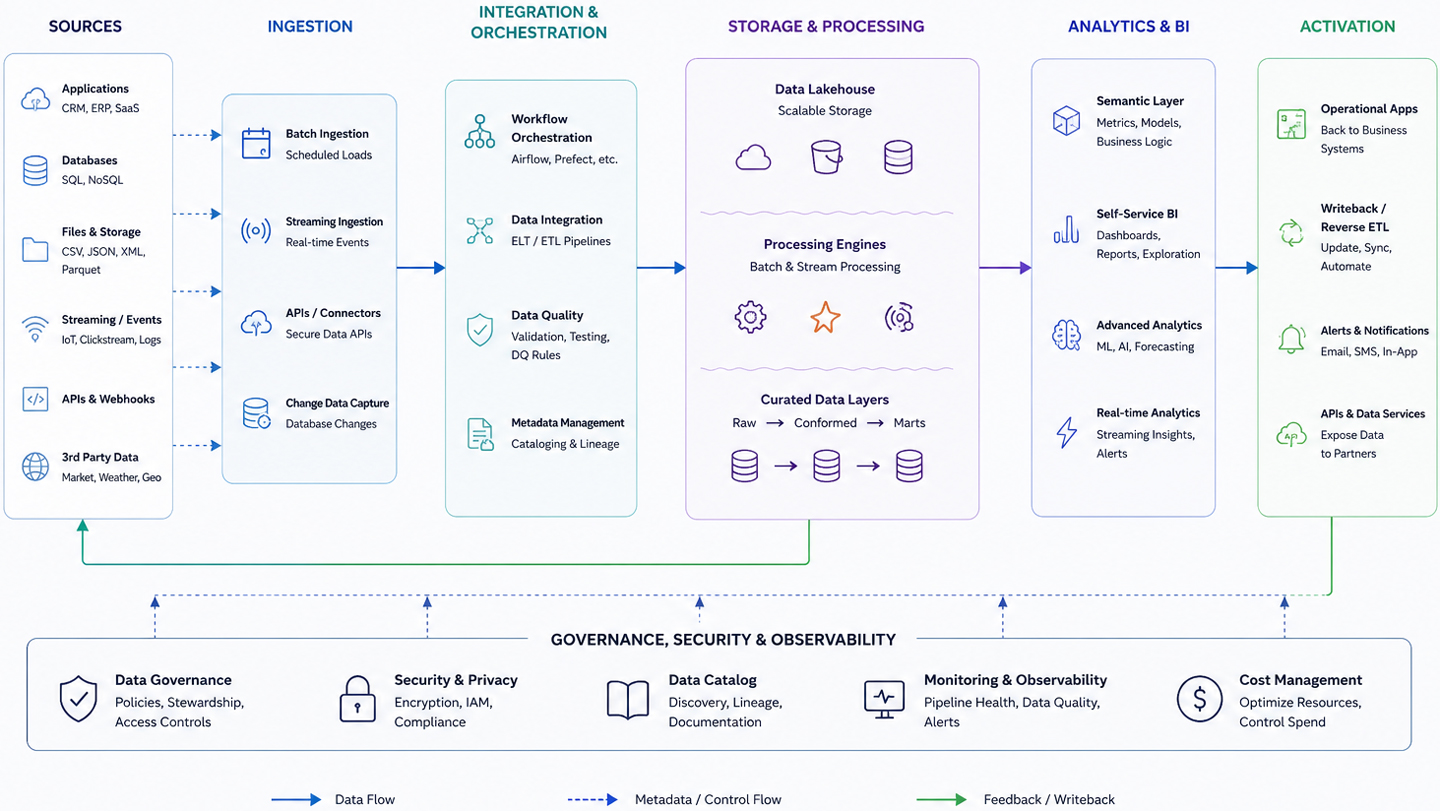
Data engineering services cover the work that turns raw operational data into a dependable platform: ingestion (the pipelines that pull data from source systems), storage and modeling (the warehouse or lakehouse where data lands and is shaped), transformation (the logic that turns raw tables into analytics-ready ones), orchestration (the schedules and dependencies that keep it all running), and governance scaffolding (the lineage, access, and quality controls that let people trust what they see).
DI Squared treats engineering as a strategy discipline, not a tooling exercise. The platform decisions made in the first six months of a build constrain the next five years of analytics capability. Choosing the warehouse pattern, the orchestration approach, the modeling layer, and the integration tooling: these are architecture decisions with business consequences. We make them with the long term in mind.
What we build
Engineering deliverables cluster into a few categories. Ingestion: extracting from source systems (ERPs, CRMs, operational databases, SaaS APIs, flat files, streaming sources) into the platform. We use Fivetran where it fits, custom ingestion where it does not. Modeling: the shaped, tested, documented tables that analytics actually reads from. We use dbt for transformation work in most modern stacks. Storage: warehouses on Snowflake or BigQuery, lakehouses on Databricks, hybrid patterns where the workload calls for it. Orchestration: scheduled and event-driven pipelines with dependency awareness and observability. Governance scaffolding: lineage, data quality tests, access controls, and the documentation that makes the platform auditable.
We also do the unglamorous work: cleaning up technical debt, retiring stale pipelines, consolidating duplicate models, and rationalizing the integration footprint. A lot of engineering value is in subtraction.
Platforms we work in
Our core stack: Snowflake and Databricks for the data platform, dbt for transformation, Fivetran for managed ingestion, Azure and AWS and Google Cloud for the underlying infrastructure, and Collibra where governance tooling is in scope. We are vendor-neutral, but fluent in the platforms that matter. We do not push tools the client does not need.
When the existing stack is workable, we extend it. When it is not, we say so plainly and document the migration case. Either path is fine. We just will not pretend a workable platform needs replacing.
How an engineering engagement runs
Discover (two to six weeks).
We assess the current platform: ingestion sources, warehouse design, transformation logic, orchestration, governance, and the team operating it. We surface technical debt, single points of failure, and the gap between what is in production and what the business needs it to do.
Map (four to eight weeks).
We document the target architecture, the platform recommendation, the build sequence, and the migration plan if one is needed. This is the document the engineering leadership can fund from and the team can build from. It is not a hundred-slide deck. It is a working architecture document.
Navigate.
We build alongside the in-house engineering team. Most engagements run in waves: foundational pipelines and the modeling layer first, then the analytics-facing models, then the operational integrations, then governance hardening. Each wave delivers value before the next starts.
Adjust.
Engineering is never finished. Sources change, business models change, and the platform has to absorb both. We stay on through Adjust to keep the platform aligned with what the business is actually doing.
Where we have done this work
Engineering work scales differently in each industry. Utilities run large operational data volumes with strict reliability requirements. Healthcare runs sensitive data with hard regulatory constraints. Manufacturing runs sensor and yield data with low-latency expectations. Retail runs transactional data at high concurrency. Financial services runs reconciled data with audit demands. Energy runs commodity and grid data with complex partner integrations. We have shipped in each.
See industries for industry-specific notes and case studies for engagement detail.
Modern Data Pipelines
Ingest. Integrate. Transform. Orchestrate. Analyze. Activate.
Data Engineering Services, answered.
Q: What is the difference between data engineering and data analytics?
A: Data engineering builds the platform: pipelines, warehouses, transformations, governance. Data analytics builds on top of it: dashboards, semantic models, self-service environments. Engineering is upstream. Analytics is downstream. A successful program needs both, and most failed analytics programs are actually failed engineering programs with a dashboard on top.
Q: Snowflake or Databricks?
A: It depends on the workload. Snowflake is excellent for SQL-first analytics workloads, governed warehousing, and teams that want a managed experience. Databricks shines for data science, machine learning, large-scale transformation, and lakehouse patterns. Many clients run both. We recommend after Discover, based on the actual data shape and team skills, not a vendor pitch.
Q: Do we need dbt?
A: Most modern stacks benefit from it. dbt gives you version-controlled, tested, documented transformations and a coherent modeling layer. If the existing stack has none of that, dbt usually pays for itself within a quarter. If it already has equivalent tooling that works, we will not push a swap for its own sake.
Q: Can you build the platform and hand it off to our team?
A: Yes, and it is the most common shape. We co-build with the in-house team during Navigate, document the architecture and the operating playbooks, and hand operational ownership over. Many clients keep us on through Adjust for senior engineering review and the next wave of build.
Q: What about real-time and streaming?
A: We design and build streaming pipelines where the business case is real (operational alerting, customer-facing analytics, fraud detection, sensor data). For most analytics workloads, near-real-time batch is the right answer at lower cost. We will tell you which one the use case actually needs.
Q: How do you handle governance?
A: Governance scaffolding goes in from the start: lineage, data quality tests, access controls, documentation. For clients with formal governance programs, we integrate with Collibra or the equivalent. For clients building governance for the first time, we scope it as a parallel workstream during Map.
Build the platform your analytics can actually rely on
Tell us what your platform is doing today and what you need it to do next. We will assess it, document the target, and build alongside your team. Vendor-neutral. Operator-grounded. Since 2008.